


The Duality of Religion and Resistance in Taqbir's Punk Politics
Taqbir channels punk into protest, responding to patriarchy and religious control with a sound grounded in resistance.
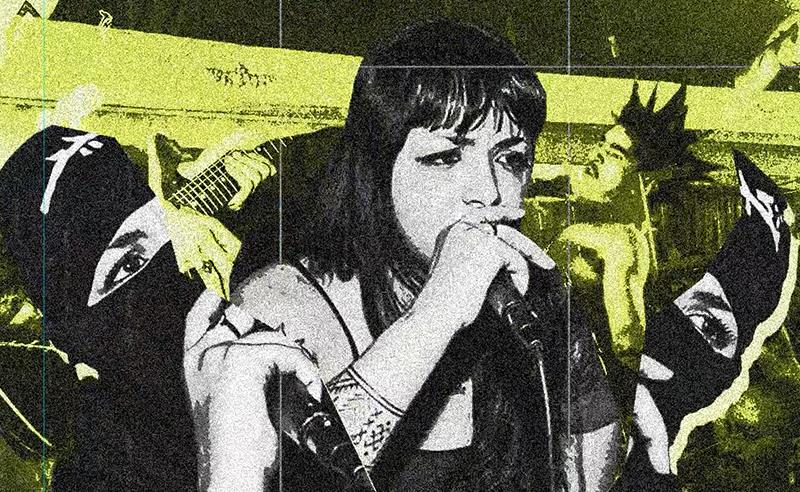
Taqbir exists in pockets, pulling the genre into a place it doesn’t traditionally belong in. It clashes with religious norms and lived experience instead of trying to smooth out obvious contradictions.
Their music feels less composed than released, unleashing an atmosphere of raw anger. The band channels pent-up frustration that had long been building. But the seed was planted well before that.
“Since I was a kid, I always liked punk. I lived it like a philosophy, a way of life,” recalls Nao, the group’s Moroccan lead singer. During lockdown, she and a friend decided to make some music. “I wanted my music to be dirty and noisy like my neighbour. No silence, no peace. Only noise.” she laughs. “I think it comes from our garage influence.”
In that little apartment, the band was born. “I remember we were deciding between two names: Taqbir or Harissa. I’m glad we chose Taqbir.”
The name is deliberate and loaded. 'Taqbir' carries sacred religious and social meaning. For Nao, reclaiming it was an act of defiance. “My intention was to take something that has been used to oppress me and make it mine,” she explains. “It is euphoria, happiness. Something bigger. God. It used to scare me, now it doesn’t.”
With no expectations, they uploaded their first EP to Bandcamp. The response was immediate. Everyone was talking about Taqbir. As attention grew, so did they. Three more members joined, transforming a bedroom project into something larger. “I remember being so anxious while reading all of the comments, but this good kind of anxiety. Seeing how excited everyone was… those were crazy days.”
Their sound is abrasive, shaped by early punk influences, particularly Australian egg punk, but Taqbir is as much about provocation as it is about music. “The zaghrita, you do that in Egypt too, is a very powerful sound,” Nao says. “Women use it to celebrate life. Conservative men don’t like it, so I try to use it the most. You can probably tell who I want to piss off.”
Operating at the intersection of free speech and feminism, Taqbir amplifies the voices of women that are oppressed. Nao points to the song that embodies the group, an unreleased track that doesn’t have a name and is only performed live. It distills their message into a single repeated line: “You discriminate against me because of your Quranic interpretation.”
“It describes who we are clearly and accounts for all women,” Nao explains. “It doesn’t matter who you are, people will find a way to silence you.”
That silencing is not an abstract concept. Nao speaks openly about the personal cost of her work, highlighting strained relationships, cultural backlash, and the suffocation of 'hchouma' (shame) culture. She describes her favourite song, Sma3 meaning ‘listen’ in Dirija, “I dedicated this song to my dad. The message is simple: mind your own business.”
This tension extended beyond the music and into how Taqbir originally chose to present themselves. One of their defining traits in their early days was their anonymity. Faces covered and names concealed, they performed behind a veil of secrecy. The easiest assumption is that it was an idea conceived out of survival, but for Nao, it was more complicated.
“When you’re anonymous, you feel more comfortable saying things, but it doesn’t actually protect you,” she admits. “Anyone can come to a show. We’ve had people get angry at us. It’s very scary.”
Eventually, Nao chose to reveal her identity, not only out of necessity to pacify the anger they faced, but to build trust with their fanbase. “I think people didn’t fully trust me when I was hidden,” she says. “There are too many cases of bands faking their origins so they can platform themselves. It becomes problematic, especially if you’re not from an Islamic background.”
Now, she feels more grounded in that visibility. Her fanbase recognizes that she has lived what they have lived. “They know I’m not a racist trying to play a relatable Arab punk girl,” she explains. “I honestly feel more powerful knowing that everyone knows who I am. I have nothing to hide. And I shouldn’t be scared.”
This visibility acknowledges the lived realities that inform Taqbir. Nao’s worldview is shaped by overlapping systems of exclusion, present in Western colonial legacies and patriarchal structures in Morocco, and in her experience as an immigrant in Spain. She navigates the weight of both, being all too familiar with rejection from her own community and the society she currently lives in.
“I’ve never felt accepted by anyone,” she shares. “I lived these two lives, both marked by oppression and involving a lot of violence.”
Within the Maghrebi punk scene, Taqbir becomes a space of reclamation, Nao carving out a territory of her own. By rejecting expectations of modesty and submission, she reframes what it means to exist as a woman within her culture. “It breaks the narrative,” she says. “Women are expected to be quiet, to conform. If you offend conservative men, you’re probably doing something right.”
Taqbir's visual language extends this confrontation. On their 2025 EP, the cover depicts the Kaaba struck by a wrecking ball, alongside a niqabi woman, imagery that would be considered blasphemous in Muslim countries.
“I am very proud to be Moroccan and as a part of my upbringing, Islamic language is woven into my everyday words. Inshallah. Alhamdulillah. Taqbir is part of this language.”
That connection does not preclude critique. “I can’t stand by hypocrisy,” she adds. “For me, Mecca represents a kind of performative religious ritual.”
Through this imagery, she explores contradiction rather than resolution. “I wanted to clearly illustrate the duality of our name and who we really are.”
Nao would encounter those same hypocrisies within the group itself. 2025 brought on a major line up change. Feeling increasingly commodified and facing recurring abuses of power within the group, she reached her limit. Contemplating ending Taqbir, she reflected on how they had become the representation she needed as a child. “It didn’t feel like it was 100% mine, I had started the band with another person, but I honestly didn’t care. Taqbir is me, it's my story, it's for those like me.” Ownership of the narrative was more important than the perfect circumstances.
Taking control meant accepting how women are often labeled when they assert themselves: being cast as an aggressor. “But I decided that’s okay.”
Today, the band consists entirely of members with immigrant backgrounds, united by shared experiences and grounded in the realities of navigating a new life in the context of adversity.
“We all understand that Taqbir isn’t just a band.” She continues, “it’s a message worth preserving.”
With the shift in its internal dynamics, their reach continues to grow past its humble apartment origins.
Currently based in Spain, Taqbir performs across Europe and is touring the United States. Much of their listenership comes from Southeast Asia. “Every week I get a DIY shirt from some Indonesian kid,” she notes. “It makes me so happy to see that, even from this far away, music always unites.”
That connection is everything. “My people, they’re the safe space I always wanted.”
Nao hopes to bring the band to Morocco this year, despite anticipating resistance. “I already talked with some Moroccan friends, and we’re trying to make it happen,” she says. “Inshallah.”
- Previous Article Jana Delivers a Sleek & Bass-Heavy Sound on New EP ‘Khazan A7zan’
Related Articles
Trending This Month
-

-
 Jul 15, 2026
 -
-
 Jul 06, 2026