

Dog Plug Capture Friction of Urban Life in Visceral Self-Titled Debut
The trio of Mazen Kerbaj, Maurice Louca and Tony Elieh come together for an electro-acoustic journey of instinct and improv.
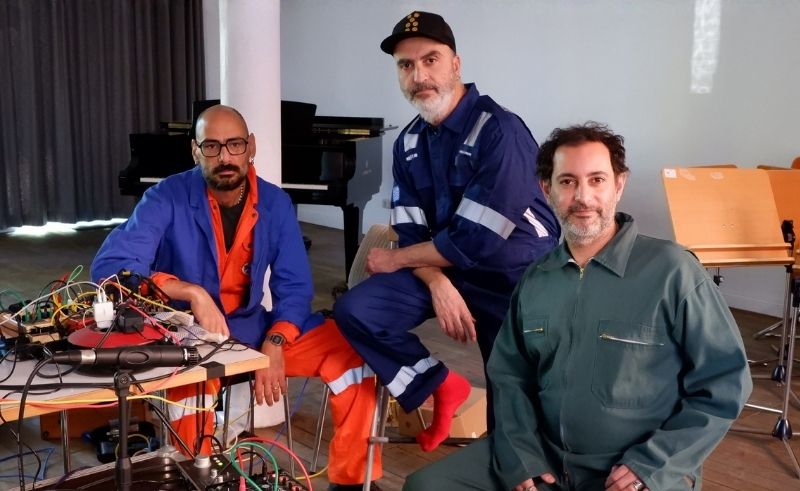
The jumper cable - known in Arabic as kilab al-bottariya - is a tool representative of urban breakdown, an object for forcing energy into a dead system through a manual bypass, a flash of sparks and the nagging anticipation that it might not work. It’s a fitting conceptual anchor for the self-titled debut from Dog Plug, a project that brings together Mazen Kerbaj, Maurice Louca and Tony Elieh - three of the most influential experimentalists in the Lebanese and Egyptian underground.
For two decades, the trio's fingerprints have left a mark through boundary-pushing outfits like Karkhana and The Dwarfs of East Agouza, collaborating in fluid ensembles across borders. Yet this project marks something of a milestone, or a shift in dynamic - for the first time, all three are living in the same city, having come together in Berlin.
Musically, Dog Plug exists in a sort-of twilight zone between the organic and the synthetic. It draws its structure from the claustrophobic tension of post-punk and the kinetic freedom of free jazz, but it quickly turns into something entirely its own, an electro-acoustic journey that feels improvised in the way it lays out a very distinct sense of psychological anxiety.
Released on Annihaya Records and mastered by Rashad Becker, the album somewhat mirrors the precarious landscape from which it emerged. Though the trio is now based in Europe, the record was tracked in Lebanon during a period of escalating conflict - demonstrated by the fact that its physical release was delayed because the designer was blocked from accessing their Beirut print shop amidst ongoing Israeli airstrikes.
This sense of disruption bleeds into the album's arc. On the opening track ‘Dakkerha’, the trio establishes a rigid, almost militaristic rhythm. The track loops with a mechanical persistence before fracturing into a frantic, chaotic chatter of noise. The atmosphere shifts into something ghostly on ‘Shamm El Hawa’, where the music hovers over an eerie mist while Kerbaj reimagines his approach to the trumpet. Drawing on his deep roots in the free-improvisation scene, he abandons any pursuit of melody, instead delivering broken gasps and pops, as if struggling for air.
In ‘Hair of the Dog’ Louca treats his keyboards more as a measured composer, while Elieh utilises tech-processing as an unpredictable creative catalyst rather than a safety net, constructing a terrifying sonic backdrop. The piece also incorporates heavily distorted vocals that mimic the frequencies of a child’s voice, with many linking into the tragedy of Hind Rajab. ‘Turning in its Ground’, shifts the tone to a slow, suffocating pressure. The track creeps forward with deep, rumbling basslines, with Kerbaj using his trumpet to create dry, mechanical clicks and Elieh’s bass holding the uneasy loop together. The album closer, ‘As Far As Your Eye’, finds the trio lingering in the wreckage of the earlier explosions. Built on vast, empty space, there’s a barren, mournful atmosphere that carries the track - not to a resolution, instead fading out in exhaustion.
On paper the album might come across as a collapse of unguided chaos. But there’s a telepathy that navigates the record's dynamics as a single, fluid organism that values the quiet hum of anticipation as much as can be just as heavy as a wall of feedback. Throughout the album, While experimental music can often feel overly-calculated and thus emotionally detached, Dog Plug lands with a visceral, jarring impact that brings out the best of a trio that can only be described as nebulous, elusive and utterly unpredictable.
- Previous Article Tunisia's Balaclava to Host Club Night With UK's Keep Hush May 17
- Next Article Artist Spotlight: Moataz Mady
Related Articles
Trending This Month
-
 Jul 15, 2026
 -
 Jul 06, 2026
 -
-