

Faraj Suleiman On Releasing 'Masaha' & Resisting The Algorithm
'Masaha' started as a song he forgot he'd written, then became two entirely different ones. The Palestinian musician opens up on the double release, and why he refuses to let trends shape his music.
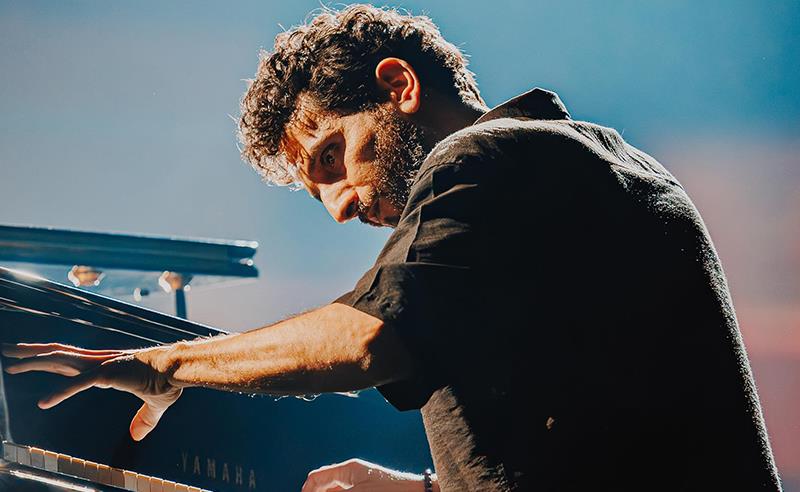
When Faraj Suleiman first rearranged the song 'Masaha', he put it aside to let it marinate for a while. When he came back to work on it again, he completely forgot the first draft. What resulted were two completely different versions of the same song, and he couldn't let either go.
As of September 25th, the two songs and accompanying music videos are out across all major platforms through independent release, and the Palestinian musician has a lot to say about the songs, the creative process they were born out of, and the current state of Arabic music.
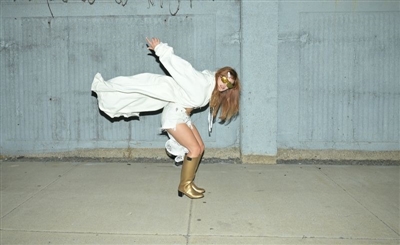
'Masaha', or 'space' in English, is a story told by two women, one still young, one decades older, both asking for space from their partner, both feeling suffocated. They ask for that space through the same lyrics, but along diverging melodies, and stages of life. "My love, I need space," they both begin.
Lebanese actress Stephanie Atala sings 'Masaha Oula' with a traditional Eastern band, or ‘Takht Sharqi’ used in classic and folk Arabic music, made up of percussion instruments like the 'tableh' and 'daf', as well as the accordion, Eastern violin, 'buzuq', 'nai', and the plucked string instrument 'qanun'. The song begins with an acoustic melody, grounded in the light beats of a drum, before she begins, "My love, I need space." Atala plays the role with restraint, her delivery never tipping into confrontation even as the lyrics ask for distance.
When Atala pauses between each of the three verses, the band picks up, playing up and down their melody. Her voice is light, joyful, positive, Suleiman describes. Her tone suggests that she wants her space, but she's understanding, she still loves him.
"You don't let me sleep, and you don't sleep either," she sings her final line, setting the stage for an instrumental outro that runs for an entire minute.
Syrian actress Amal Arafa's 'Masaha Tenyeh', however, carries the introspection and exhaustion of a couple more decades of experience. She's reached her limit. Where Atala sounds like she's still choosing her words carefully, Arafa sounds like a woman who's run out of them.
The Eastern band is replaced by a simpler melody on the piano, drums, and Western orchestra. Arafa's voice drops a few octaves from Atala's, as she draws out each vowel and elongates each word in the opening verse.
Then the piano cascades forward, fingers running across the keys. It subsides as Arafa begins the second verse. "When I met you, you told me, there is no one but you," she sings with a hint of sarcasm.
The piano picks up again before her final verse: "With me, you have no hope." The orchestra leads the same last line as Atala's into a shorter instrumental outro, dominated by the piano.
"The original song came out in 2012," Suleiman explains. Fourteen years ago, he took the words of his friend Alaa Abu Diab's Facebook post, a Palestinian comedian, and added music to it. He recorded and released it in a single day with Terez Suleiman on vocals.
Coming back to the song over a decade later, then accidentally arranging two songs with the same lyrics, is emblematic of Suleiman's involved creative process, one that requires research, study, stillness, and time. But increasingly, that slow, intentional process is being sidelined by the demands of social media and the Instagram algorithm.
"I think our situation is worse than it was in the eighties or mid-nineties, when people used to say Arabic music was dying out," Suleiman says. "Today it's even harder. Most people are working on how to get more likes and followers. This was never how composers or writers used to think."
For Suleiman, success won't come from chasing the next trend. "What actually helps you succeed abroad more is being distinct and local," he says. "The more local you are, the more international you become."
"If foreigners come across me and like my work, that's great, but what matters most to me is when I'm singing for a Palestinian, a Lebanese, a Syrian, an Egyptian, whoever," he elaborates. "I care about the Arab audience."
Suleiman shot both music videos for ‘Masaha’ in Beirut with director Elie Fahed, one of the many cities he stopped in on his tour this past summer, one that also included the Festival International de Hammamet in Tunisia and the Roman Theater in Amman. He ended the season back home in Haifa, doubling shows with family visits before heading back to Paris, where he has been based for the past two years. Next, he'll hit Canada, on a tour that begins in Edmonton on October 24th, before Toronto on the 29th, and ending in Montreal on November 1st.
Suleiman has secured his name in households across the Arab world for his distinct voice, but he was once dedicated solely to instrumental jazz piano. He first touched the keys at three years old, before stepping away from lessons through his teens and into university, where he mostly taught himself, continuing without formal study ever since, except for some lessons from his uncle.
In 2018, Suleiman left Haifa for Paris for the first time for a music residency at the Cité Internationale des Arts. "I spent two years there, and during that time I built my whole network, all the professionals in the music industry," he says. "I knew everything there, except for the language," he laughs.
Those years in Paris, he was still focused mainly on instrumental music. With the release of his most popular album 'Better Than Berlin' in 2020, his first major singing project, he returned to Haifa to develop the vocal side of his craft, then moved back to Paris as his profile grew, drawn by the city's role as a regional hub and its art scene.
"'Better Than Berlin' was my turning point," Suleiman says of the 11-song album, an ode to Haifa's seasons, neighbourhoods and drama. It's home to 'Questions on My Mind', his most famous track, with nearly 40 million views on YouTube and counting as of September 2026, an irony not lost on a musician who now warns that chasing views is corroding Arabic music. The album was also the fruit of a partnership between Suleiman's music and Palestinian writer Majd Kayyal's words, which, like Abu Diab's lyrics for 'Masaha', started as a friendship.
"When we came out with 'Better Than Berlin', artists weren't focused on 'how to go viral'," Suleiman says. "Of course every artist wanted to become well-known, but it wasn't such a central part of the initial creative process."
"I'm lucky that I started making art before all this came along," he says, "so I know what it's like to create without having to think about anyone else."
The pressures of virality are pushing artists away from innovation and into commercialisation, Suleiman adds, a dangerous path for music. "If you do anything and it goes viral, people stop caring whether the work is actually musically good or not, what matters is that it's trending. That's not really art, that's business."
When asked if that commercialisation pushes Arab artists to appeal to Western audiences, Suleiman says a lot of people make the same mistake. "People think that when you start making music that sounds Western, that's your way into the Western world, and it's actually the exact opposite," he says. "The Western world is always looking for something it doesn't already have. If you make music that sounds like America or anywhere else, they have no reason to listen to you, they already have plenty of that."
As he said before: "The more local you are, the more international you become."
Suleiman's next release after 'Masaha' is a six-song children's album sung by and titled after his niece, Sama. It follows 'Faheem' (2021), the same format built around her brother, Suleiman's nephew, recorded when he was nine.
"This album is different from children's albums in general, because it comes from the child's point of view, not some grown-up trying to teach lessons about how we should live, things like 'brush your teeth' and 'go to bed early' and all that educational, moralising stuff," Suleiman says. "On the contrary, it comes from Sama's own perspective, how she sees the world and what she's going through."
"I want people to listen to the album and love it," Suleiman says. "That's my whole ambition."