

SceneNoise and Spotify Present: Hear & Now
We unpack the data in Spotify's latest economic report with five exclusive interviews on the growth of Egypt's streaming growth, global export power, and evolving music economy.
In recent years, Egypt's music ecosystem has undergone a complete overhaul. With the rise of multiple subcultures such as Egyptian rap, mahraganat, and alternative pop, the reality of Egypt’s music scene has been expanding rapidly with homegrown independent movements growing to represent a massive portion of the country’s music output.
This structural and creative explosion is not slowing down any time soon. To truly unpack the specifics of this momentum, we teamed up with Spotify to dive deep into their latest 'Loud & Clear' report while going straight to the source. In this feature, we combine key platform insights and industry data with exclusive interviews conducted directly with some of the essential figures shaping the Egyptian music scene today.
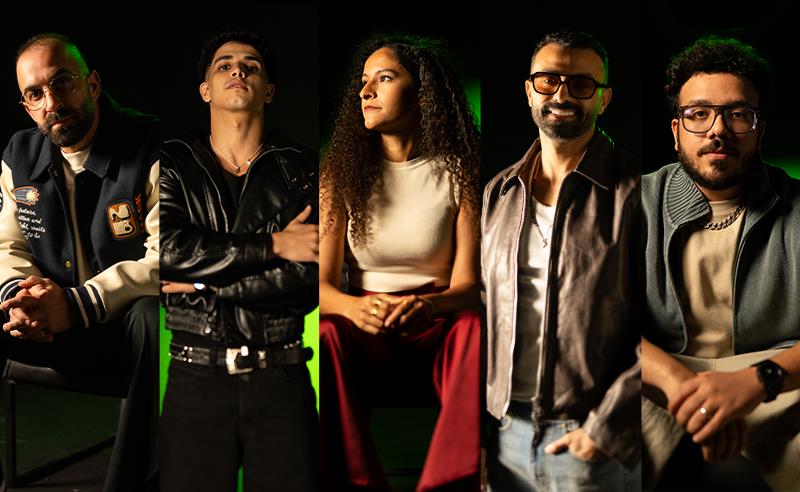
From mahraganat trailblazer Fares Sokar and genre-fluid singer-songwriter Samar Tarik, to industry infrastructure builder Mohamed El Shaer (co-founder of The Basement Records), visionary sound architect Coolpix (Ehab Mostafa), and Spotify’s Head of Music for MENAT+, Mark Abou Jaoude, we take a comprehensive look at how Egypt’s scene is claiming its place on the global stage.
-0e0fa3c0-c0f3-41cc-9359-662a0d84a52b.png) A Deeply Local Scene with Expanding Global Reach
Egyptian music commands profound loyalty at home. Data from 'Loud & Clear’ highlights that Egyptian artists accounted for over 86% of the tracks featured on Spotify's Egypt’s Daily Top 50 in 2025, meaning that audiences listened to more homegrown releases than global hits. Yet, this domestic chart dominance is paired with staggering international export power; as 85% of all royalties generated by Egyptian artists on Spotify in 2025 came from listeners outside of Egypt, spanning top export markets like the United States, Germany, the United Kingdom, France, and the Netherlands.
To better understand this duality, we spoke with mahraganat star Fares Sokar, whose creative journey is deeply anchored in the organic growth of the mahraganat and shaabi movements. Drawing early inspiration from pioneers like Sadat El 3almy, Figo, El Madfaagya, and Felo, Sokar's transition from raw underground shaabi anthems to viral commercial success hinged on developing a distinct personal brand and persona, which he accomplished by leaning into romantic flirtation as an interactive theme for his hits.
"What distinguishes you is your personality and the character you present to people. I play a lot on the ‘lover-boy’ persona. People loved that side of me, so I doubled down on it." - Fares Sokar, Artist
His surge in international listeners, however, came through his collaboration with Palestinian-Algerian pop phenomenon Saint Levant, whose foray into the mahraganat genre materialised via their collaborative release ‘Do You Love Me?’, in which both artists leaned heavily into their loverboy personas. For Sokar, this success was capitalized upon by turning to short-form video choreography and catchy hooks, where he noticed that digital platforms were organically breaking geographic and language barriers, pulling millions of views from non-Arabic speakers across international markets who connect purely with the infectious rhythmic energy of his tracks.
"When you look at social media, you find tens of thousands of videos being made with my tracks. Half of the people are non-Egyptians, non-Arabs, who don't even understand what is being said. But there's this momentum: there’s a certain dance that everyone does." - Fares Sokar
-3e8b09a9-6384-4baa-93e3-b0600ed2065d.png) Discovery and Changing Pathways to Audience
In 2025, Egyptian artists were discovered by first-time listeners over 549 million times on Spotify, marking a 12% increase since 2024. These millions of discovery moments show how modern streaming pathways connect independent creators with new global audiences every single day.
For independent singer-songwriter Samar Tarik, navigating this digital landscape means rejecting standard industry formulas in favor of poetry-first songwriting that tackles psychological depth, mental health, and human vulnerability rather than relying exclusively on conventional love tropes. As a multi-instrumentalist and producer who moves fluidly from electro-indie collaborations with artists like El Waili into intimate acoustic and classical Arabic arrangements, Tarik actively resists being boxed into narrow genre categories by the music industry.
"Since I play multiple instruments and produce as well, I have the space to explore. In my career as a female artist, I try to do something different that hasn't been done before." - Samar Tarik
While digital streaming platforms provide unprecedented global reach, Tarik emphasises that the physical stage remains an irreplaceable anchor for genuine human interaction, highlighting moments like selling out her show at the Cairo Citadel and witnessing multi-generational families and fans singing along in real-time as proof that music forms lifelong personal bonds.
"Live performance is obviously very important. It's a human platform that keeps showing me how much my music means to people." - Samar Tarik
Additionally, Tarik reflects on the regional audiences she has built over the years, with listeners urging her to perform around the Gulf and the Levant.
"All of a sudden people were sharing my track ‘2002’ in Saudi Arabia and Iraq. People were also messaging me to perform in Syria and even Gaza." - Samar Tarik
-786d6fc6-ed39-4b01-851b-6c99367d5d95.png) The Growth of the Music Economy
As the music scene in Egypt continues to grow, the financial architecture of its industry keeps undergoing radical transformations. Underpinned by a thriving independent scene, as well as a historied roster of legacy artists who remain active to this day, royalties generated by Egyptian artists from Spotify alone in 2025 increased by 35% year on year, highlighting the growing economic opportunities that streaming is creating for Egyptian artists.
Industry pioneers like Mohamed El Shaer, co-founder of The Basement Records, have driven this structural evolution from the ground up. Having started making music with legacy artists such as Angham in the early days of digital media, The Basement Records quickly grew a strong reputation for quality results with a cutting-edge mindset that understands the demands of an ever-changing industry.
During the COVID-19 pandemic, the label came to work with over 20 prominent rappers including Marwan Moussa, Afroto, Marwan Pablo, Joker, and Moussa Sam. Recognizing that modern independent artists needed more than just a platform to upload music, El Shaer built The Basement into a comprehensive "creative hub" that manages the holistic enterprise overseeing visual identity, brand partnerships, strategic roadmaps, and tour logistics. Beyond just administrative support, El Shaer's vision was rooted in pushing these underground movements into the mainstream cultural conversation, aggressively chasing high-profile brand deals and structural mainstream visibility that permanently elevated Egyptian hip-hop into a commercial powerhouse.
“The Basement Records invested in the rap scene before it was a thing. The first person we signed was Joker in 2011. Then, during COVID, we signed more than 20 rappers: Marwan Moussa, Afroto, Pablo, Moussa Sam, and many others." - Mohamed El Shaer
Financially, El Shaer points out that predictable monthly streaming revenue gives creators the stability needed to take artistic risks and reinvest in higher-quality production, though he notes that closing uncollected publishing rights remains the next critical economic frontier for the regional ecosystem.
"Streaming gives artists the edge of having stable income every month, and as they release more music, that revenue increases." - Mohamed El Shaer
-35615f97-fb6b-403f-b4f8-f5b15f0f40bf.png) The Diversity of the Ecosystem and Emerging Sounds
Behind all of this growth, Egypt's contemporary scene showcases a colorful variety of sounds, with Egyptian hip hop, Arabic hip hop, electronic, and Egyptian shaabi being among the fastest-growing genres in terms of royalties generated by Egyptian artists on Spotify alone in 2025. This creative boom is powered by versatile producers acting as true co-architects of modern music.
Producer Coolpix (Ehab Mostafa) approaches his craft with relentless curiosity, treating every studio session as an opportunity to learn from collaborating artists and expand his technical palette across diverse musical movements. Describing the psychology of the studio, Coolpix highlights the intimate, risk-taking dynamic between producers and vocalists where sound architects guide complete project identities, sometimes keeping studio experiments or minor happy accidents under wraps until they transform into groundbreaking sonic textures.
"Every day I want to learn something new, and make a new song. I learn something from every new artist I work with. By making the music that they have in mind, I add to my knowledge and skillset." - Coolpix, Music Producer
Reflecting on the evolving market, he notes how traditional barriers have dissolved. Whereas mahraganat historically offered an open door for raw, democratic experimentation, modern producers and alternative pop creators now fluidly merge local Egyptian soul with global sensibilities, bridging the gap for a young, genre-agnostic generation of listeners.
"When I started making music, mahraganat's door was open to everyone. Any artist could sing in that genre, whereas pop needed you to have a strong background. Today, alt-pop is changing that by offering an accessible version of what pop is trying to do." - Coolpix
-1907fe93-1c55-4500-90f0-b2d8268aaa83.png) Demystifying Streaming Economics and Royalty Infrastructure
Financial literacy and data transparency are a vital part of Egypt’s continuous growth. Globally, Spotify paid more than $11 billion to the music industry in 2025, bringing cumulative payouts since its launch to nearly $70 billion.
As Spotify's Head of Music for MENAT+, Mark Abou Jaoude emphasizes that the explosion of Egyptian pop, hip-hop, and mahraganat is deeply tied to how organically artists connect with their domestic audience, commanding over 86% of Spotify’s Daily Top 50 in Egypt in 2025 while simultaneously generating 85% of their royalties from international markets like the US, Germany, the United Kingdom, France, and the Netherlands.
"The music scene in Egypt is very connected to the audience. Over the years, we've seen how artists connect with their listeners across a variety of genres like hip-hop, mahraganat, and pop." - Mark Abou Jaoude
To support this rapid growth, Abou Jaoude stresses the platform's commitment to financial education - demystifying how subscription and ad-supported revenue pools operate under the streamshare model so creators understand exactly where their money flows and how rights are collected.
Exact royalty payouts based on this model fluctuate based on a range of variables - including whether a listener is streaming via an ad-supported free tier or a premium subscription, the geographic market of the stream, and local monetization rates.
“It’s very important to let artists know where the money flows, where money is coming from, and how it’s distributed between rights holders." - Mark Abou Jaoude
Furthermore, by leveraging tools like Spotify for Artists, creators are equipped with granular geographic data and audience segmentation (spanning monthly active listeners, previously active listeners, and programmed listeners) to make smarter touring and business decisions.
"Spotify for Artists helps many artists understand their audiences, understand the business ecosystem. It enables you to know where your music is streamed from a country and even city level, which helps you plan shows, and develop a more engaged listenership." - Mark Abou Jaoude
- Previous Article Shuffle | Nov 5 - Nov 18
Related Articles

Trending This Month
-
 Oct 31, 2026
-
-

-