

DJs from 1948 Palestine Are Building a Music Scene With No Address
A generation of Palestinian DJs lost the only venue that was theirs, and decided that anywhere they gather counts as ground they hold.
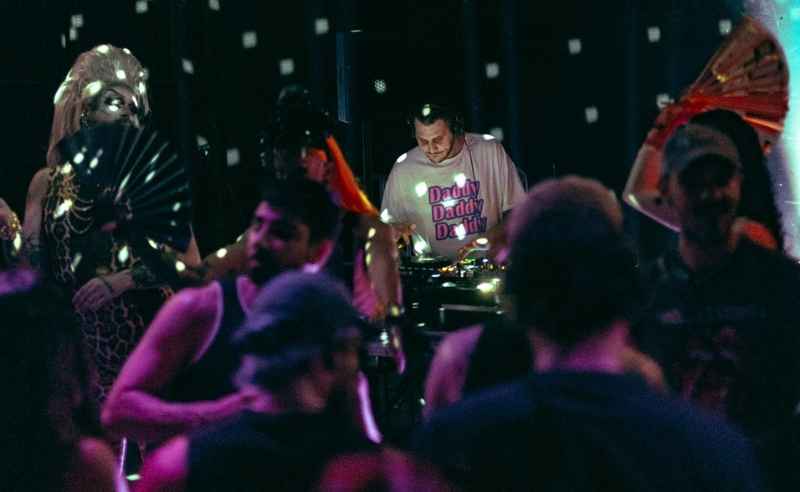
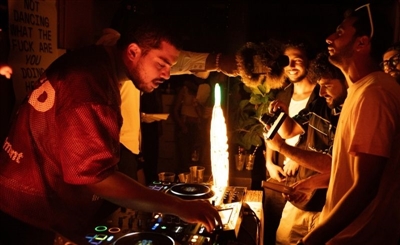
On the last night Kabareet was open, missiles crossed the sky over Haifa while Sameer Hussein played dark techno to a crowd that already knew it had come to say goodbye.
It was late September 2024. Kabareet, the last Palestinian-run club left in ‘48 Palestine, had booked 20 DJs for a farewell that ran close to 12 hours.
Hussein, who performs as Sarv, drew the prime slot, 1am to 3am. As his set climbed, sirens went off and the boom of Israeli interceptions folded into the bass.
Word moved through the room that Israeli forces had killed the Hezbollah leader Hassan Nasrallah, news that would be confirmed within hours.
An hour after Hussein stepped off, he was on his way to the airport, bound for Romania, doing the one thing left for a Palestinian artist with an Israeli passport: leaving.
-ccf166d7-4ccc-4322-b29a-e2e0574819de.jpg)
"Kabareet was our place," Hussein, 26, said. "If you're a Palestinian artist, a DJ, based in Haifa, that's where you perform. Besides Kabareet, we didn't have anywhere else to go."
He would spend the following months working the only way open to him, in Jordan, France, Spain, Romania, any place that was not home.
Kabareet opened in 2015 and spent nine years anchoring the cultural life of the 1948 Palestinians.
The name comes from the Nakba. In 1948, Zionist militias and then the new Israeli state emptied more than 500 Palestinian towns and villages and drove out around three-quarters of a million people, and Palestine was replaced on the map by Israel. Some families held on and stayed on their land inside the new borders. They were made citizens of the state that had just dispossessed them, and their descendants are around one in five people living there today.
Two pieces of Palestine survived the 1948 Nakba, the West Bank and Gaza. Israeli forces took both in 1967 and have occupied them ever since. It is the same dispossession, nineteen years apart, and it left one half of Palestinians who remained within the state’s original borders holding Israeli passports and the other half holding none.
Haifa, on the coast, has long been a cultural capital for ‘48 Palestinians. And Kabareet was at its heart. By the time Sarv took the stage, the venue had been fading for a while. Some regulars started boycotting it after it booked Israeli acts, and after October 7th, it completely crashed, Hussein said. When it shut down for good in 2024, it left an underground Palestinian music scene with nowhere to put itself.
"Now we don't have any venues left," Hussein said.
Since returning to Haifa he has been hunting for places to host his new collective, and now record label, Deviousco, but every option is Israeli-owned.
"90% of the time, you rent a place from Israelis and throw a party as a Palestinian collective," Hussein said.
For many of them, that arrangement stopped working after October 7th. Venues they had trusted and Israelis they thought stood with them revealed themselves otherwise, several DJs said. Owners and staffers were called up to serve in the war on Gaza.
-16653827-f507-44f9-b105-945e81f20325.jpg)
The building that housed Kabareet was bought by a Russian-Israeli group called Podval, which kept booking Palestinian artists for a time.
This past March, Podval cancelled a set by a queer women's collective, XOXO, at the last minute. Hussein said he never got a full explanation. Dancers who had filled the venue's nights suspected the collective's Palestinian identity was the reason. The community is now boycotting the place.
"For two years I've been looking for a space that makes sense to me," Hussein said. "I wasn't going to compromise for Podval."
So he looked south, to Jaffa, one of the cities targeted by Zionist forces in 1948 who displaced 95 percent of the indigenous Palestinian population.
Jaffa's Palestinian scene is younger and smaller than Haifa's, seeded by electronic collectives like Arabs Do It Better, which splits its time between Jaffa and Berlin. It is where Hussein found 26-year-old Sleman Altehe and his collective, Jawad.
The two had an event set for the end of January, and Altehe had worked out how to keep it safe. Anyone who wanted the address first had to fill out a form and pick one of three phrases: "JFK has an expiration date," "return is a matter of time," or "walls will fall."
Each is an anti-Zionist refrain, an if-you-know-you-know password. "That's how we know if people are chill," Hussein said.
The screening is new. "Before October 7th, it was easier to go to a party, even an Israeli one," Altehe said. After, the ground shifted.
"The Israeli venues, and some of the Israelis we thought were with us, turned out not to be. I can't organise a party at a venue knowing the owner or the booking manager just came back from Gaza."
The landlords were the easier problem. Beyond the people they were renting from, it was a sensitive time to throw a party at all.
"When we party we don't forget about the genocide in Gaza. We cannot just disconnect."
He organised anyway. The first Jawad night, at the end of 2023, ran out of a friend's house in a wealthy, mostly Jewish neighbourhood. No tickets, no social media, just word of mouth.
-7680ed1e-cb42-4877-a3bd-b0a4e81d016c.jpg)
Altehe figured the police might come. He took the risk anyway and about 80 people showed up. The room was mixed. A few were anti-genocide Jewish Israelis from activist circles.
"Some of them told me it was new to feel like a minority in a space," he said. "Others said it was new to dance knowing no one around them supported the genocide."
The next venue was in a stranger's house, filthy, its tenant close to homeless. It was the best option they could find, even though the party was illegal.
Jawad sold alcohol to cover costs, which required a permit they did not have, so a raid was always a possibility. Once, mid-set, it happened.
"I was in the middle of a great set," Altehe said, still pained by the memory. The collective kept a Jewish-Israeli lawyer friend on standby at every party for exactly that moment.
After five of these nights, Jawad moved to a proper venue, which could only be Israeli.
"Do you know how hard it is for a Palestinian to own a place?" Altehe said. Being openly queer narrows the odds again.
"We don't just need a Palestinian to own the space. We need a progressive Palestinian. That's a lot to ask."
Mahmood Halwani, 24, knows the odds too. He runs Makhluta, a queer collective out of Haifa.
"Makhluta means a mix," he said. "Straight people, trans people, all of it. A space for everyone."
Halwani came up in the Kabareet years and tended bar there. He spent a stretch DJing in Tel Aviv, where the nights that became Makhluta started, then moved back to Haifa for the larger Palestinian scene.
In the past few years Makhluta has thrown more than a dozen parties, run on the same security as Jawad. He approves each ticket himself, releases the location the day of or gives only a street name, and keeps a bouncer at the door. The night opens at 11pm as a gathering of friends and becomes, by the early hours, a techno rave.
When he first came home he threw parties under Kabareet's new ownership. Regulars stopped showing, uneasy in an Israeli-owned room, so he took two months off to find a Palestinian landlord.
He landed a short-term rental, then lost it. Now he has a single mission: a space Palestinians own outright.
"I want a space for everyone that, in the end, belongs to Arabs," Halwani said. "So it's understood that we're always here, and we always will be."
He pictures a full cultural house, DJs by night, bazaars by day, a standing invitation to artist friends from Europe. "God willing it works out," he said.
"We'll have our own place. Somewhere that makes room for anyone who respects what it stands for." Halwani paused. "What every Palestinian artist living here, on the inside, stands for."
Altehe has a phrase for the thing all three of them are chasing: "A place where we make our own rules."