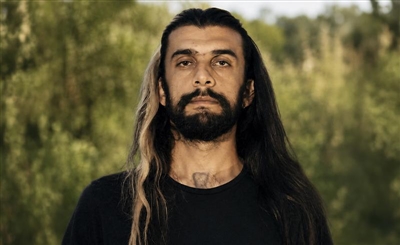


Jan Blomqvist on Preserving Human Imperfection & Live Euphoria
Ahead of his solo performance at Cyprus' BEONIX Festival, German producer and live act talks about concert techno, his musical philosophy, and his thoughts on AI in music.
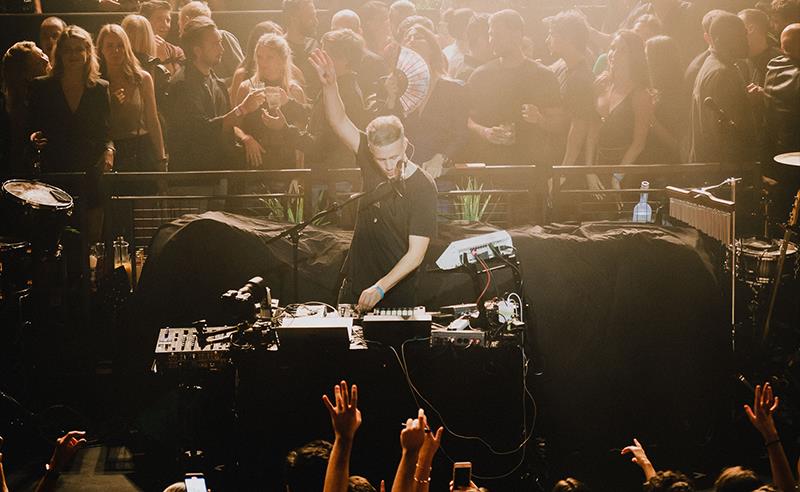
There has always been a strange expectation placed on electronic musicians when performing live. A guitarist has strings to pluck, a drummer has skins to strike. Their movements offer a visible manifestation of the sound filling the room. Electronic artists, working with laptops, controllers and synthesiser hardware, are often asked to account for their performances in a way that other musicians aren't.
It is partly why the “just press play” accusation refuses to disappear. The assumption is that if the audience cannot see exactly how a sound is being made, there must be less happening behind it. In reality, electronic performance involves its own set of decisions, from mixing and filtering to rearranging and manipulating sounds as they happen. The difference is that much of this work takes place outside of the audience’s immediate view.
Some artists answer that skepticism with elaborate stage productions. Others build sets around complex hardware, improvisation and live instrumentation, bringing a degree of uncertainty back into the performance. Jan Blomqvist belongs to the latter camp, though his approach has less to do with proving a point than with preserving something he has always valued in music: the feeling that a performance is happening for the first and only time.
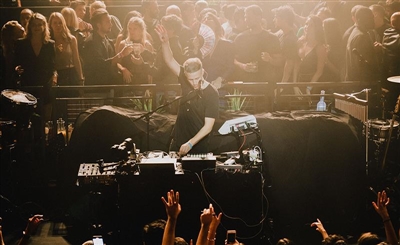
His shows are patient, melodic and driven by the interplay between vocals, synthesiser work and electronic production. There is a physicality to the way he performs that recalls a rock frontman, but the music never loses its connection to the dance floor.
But before becoming a fixture on global festival circuits, Blomqvist spent his early years playing guitar in punk and grunge bands across Northern Germany. Then he moved to Berlin in the early 2000s, where he found himself drawn into the city’s underground techno scene. The music offered a different kind of freedom, but he was not interested in abandoning the qualities he had grown up with. Instead, he began looking for ways to bring the immediacy of live instrumentation and songwriting into electronic music. And so he developed a distinctive live language that became widely known as ‘concert techno’.
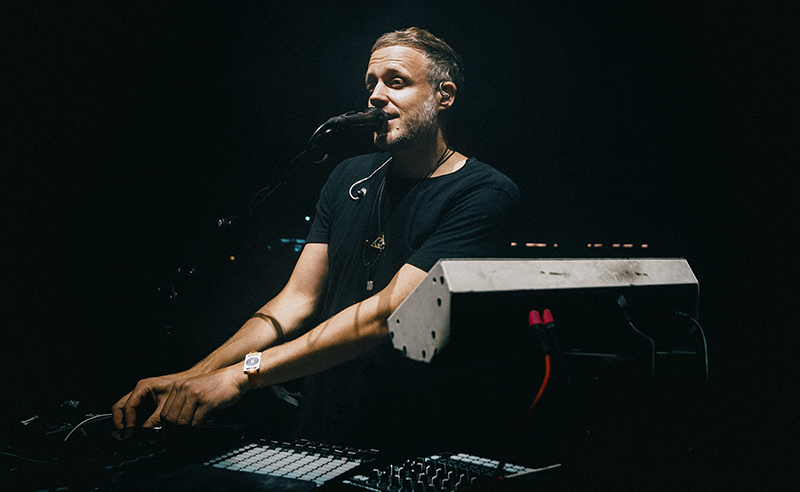
Blomqvist's live setup is remarkably intricate, combining digital production with analogue hardware, live vocals and instruments, while his approach to touring leaves room for new material to evolve in front of an audience. Rather than treating the stage as the final destination of a finished record, he has spoken about using it as another part of the creative process, a place to test ideas, respond to a crowd and allow the music to change with the moment.
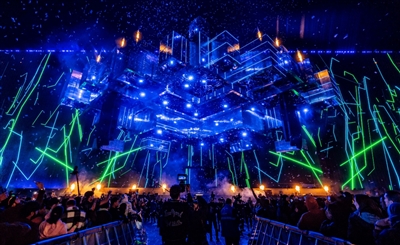
It is a philosophy that has taken him well beyond Berlin’s underground venues. Three appearances at Coachella, years of performances at Burning Man and headline tours across Europe, the Americas and beyond have established him as a familiar presence on the international electronic circuit.
Beyond the international stages, Blomqvist’s music has also found audiences in major festivals across the Middle East and North Africa, including MOGA Festival in Morocco, Sandbox in Egypt and Soundscape in Istanbul to Dubai, where his touring schedule has repeatedly brought him back to the city’s electronic circuit. His upcoming return to Bohemia Beach Club at FIVE Palm Jumeirah in October further reflects that continuing connection.
Now, as electronic music becomes increasingly shaped by AI and algorithms, polished digital production and an endless pressure to optimise what comes next, Blomqvist’s appeal lies partly in his refusal to make the human element disappear. There are still wires to fail, instruments to retune, vocals to carry across a room and moments that cannot be replicated exactly twice. He has experienced the less glamorous side of that equation first-hand, including a famously malfunctioning Moog during his Coachella performance, but those imperfections are inseparable from what makes a live performance feel alive in the first place.
Ahead of his performance at Cyprus’ BEONIX Festival, a meeting point for European, Mediterranean and Middle Eastern audiences - running from September 25th to 27th- SceneNoise caught up with Blomqvist to talk about the beauty, and occasional chaos, of making live electronic music; from hardware failures and the instinct to adapt on stage to resisting algorithm-driven production and preserving vulnerability in a genre that is increasingly capable of making everything sound perfect.
 You have also built a strong presence in the MENA region, from beach shows in Dubai to major regional festivals. How do you feel the energy and emotional receptivity of Middle Eastern audiences differ from crowds in places like Ibiza or Tulum?
Jan Blomqvist: I think every place has its own energy, and even within the MENA region, the differences can be huge. What I really enjoy there is the curiosity of the audiences. I often feel that people are very focused on the music and open to going on a longer journey with you, which works really well with the way I play live.
Ibiza and Tulum have their own very established electronic music cultures, and people arrive with certain expectations. In many places in the Middle East, I still sometimes feel this excitement of a scene that is growing and changing very quickly. That can create a really special energy. But in the end, once you have a good crowd in front of you, the differences become much smaller. Music connects people in a pretty universal way.
Across Disconnected and MUTE, you keep returning to the tension between wanting connection and needing to withdraw from the noise. Is that the central thread behind your writing, and has your relationship with it changed over the years?
Jan Blomqvist: Yes, I think that tension has always been somewhere at the heart of my music. I love being around people, playing shows and sharing these intense moments, but at the same time I really need periods of silence and distance to create. Disconnected came from that feeling of being constantly connected digitally while somehow becoming more disconnected from each other, and MUTE took that idea into a more personal direction.
I don’t think the tension has disappeared over the years. If anything, the world has become even louder. But I’ve become better at accepting that I need both sides. Connection gives me energy and inspiration, and withdrawing from it gives me the space to turn those experiences into music.
In a time when AI can create songs instantly, why does performing everything live with real instruments and vocals feel important to you?
Jan Blomqvist: Because for me, music has never been about perfection. It’s about the human element – the small imperfections, the interaction between musicians, the way a voice changes depending on the moment and the energy in the room. That is something I don’t want to lose.
AI is an incredible tool, and I’m curious to see where it goes, but the easier it becomes to create something perfectly polished, the more valuable I think real human performance becomes. When Christian plays the drums and I sing and play the instruments live, every show is slightly different. Things can go wrong; we react to each other and to the crowd. For me, that vulnerability is a big part of what makes live music feel alive.
You are performing live at the BEONIX Festival at the historic ETKO site in Limassol, Cyprus, a key electronic music gathering bridging Europe and the Middle East. What does it mean for you to be part of the festival this year, and what are you most excited about?
Jan Blomqvist: I’m really looking forward to BEONIX. Cyprus is in such an interesting position between different cultures and scenes, and I like festivals where you can feel that different audiences are coming together.
I’ll be playing my solo live show this time, which gives me a lot of freedom to react to the crowd and shape the set in the moment. I’m excited to bring that side of my music to Limassol and see where the night takes us.
Touring with delicate synth hardware, sound cards, and analog gear can be notoriously unpredictable compared to carrying a simple USB drive. What has been the most challenging technical breakdown or gear emergency you’ve had to solve in real time on stage?
Jan Blomqvist: I’ve had pretty much everything happen over the years – computers freezing, sound cards failing, synths suddenly not responding, cables dying in the middle of a show. When you play live with a complex setup, at some point you learn that something will go wrong.
One of the most painful ones actually happened at Burning Man. We recorded an entire set, but afterwards discovered that we had lost the whole recording because the equipment simply couldn’t handle the combination of extreme heat and dust. That one hurt.
Burning Man is probably the ultimate stress test for electronic equipment. After more than 1,000 shows, you learn to deal with technical problems on stage, but sometimes there is simply nothing you can do. It also reminds you why the actual moment matters - sometimes the people who were there are the only ones who will ever experience that particular show.
The biggest lesson for me has been not to panic. You keep playing with whatever is still working, find a workaround and sometimes the audience doesn’t even notice. After more than a thousand shows, improvising around technical problems has almost become part of playing live.
Many electronic artists today feel pressure to produce short, algorithm-friendly clips for social media. As an artist focused on slow-burning, long-form emotional journeys, how do you protect your creative process from those industry demands?
Jan Blomqvist: I try not to let the format dictate the music. Of course I understand how important social media has become, and sometimes it’s fun to play with it, but I would never want to write a song around the first ten seconds of a video just because an algorithm might like it.
My music often needs time to develop, and the same is true for my live sets. I still believe people have the attention span for a real journey if you give them a reason to stay with you. So I prefer to create the music first and then find a way to communicate it in shorter formats, rather than doing it the other way around.
You played a pivotal role in bringing live instruments, real harmonies, and song arrangements back into modern techno. Looking at today's melodic techno scene, do you feel artists are maintaining that organic authenticity, or is the genre leaning too heavily into repetitive digital tropes?
Jan Blomqvist: I think there are incredible artists in the scene, but of course there is also a tendency for successful sounds to be repeated until they become a formula. That has always happened in music, not only in melodic techno.
For me, the interesting part starts when you can hear the personality of the artist behind the production. It doesn’t necessarily need to be a real instrument or a vocal – electronic music can be completely digital and still feel deeply human. I just personally come from songwriting and playing instruments, so bringing those elements into electronic music has always felt natural to me. I’m much more interested in individuality than in whether something is analog or digital.
You started your label, Disconnected, around the idea of people being constantly online yet feeling distant from one another. Do you think live music events help people build real human connections again?
Jan Blomqvist: Absolutely. That was one of the main ideas behind Disconnected from the beginning. We have never been more connected technically, but that doesn’t necessarily mean we feel more connected as people.
A live show is one of those rare moments where thousands of people can share the same experience at exactly the same time. You look around, you see people dancing, singing, meeting each other, and for a few hours the digital world becomes less important. That feeling of real connection is probably one of the main reasons I still love touring so much.
When transitioning from intimate club spaces to mainstage festival slots in front of tens of thousands of people, how do you maintain the vulnerable, singer-songwriter atmosphere that defines your music?
Jan Blomqvist: I actually try not to change too much. Of course, the production can become bigger on a festival stage, but emotionally I still approach the songs in the same way. When I sing, I’m not really thinking about whether there are 500 or 30,000 people in front of me.
Sometimes those huge stages can even create surprisingly intimate moments. If you allow a song to become quiet and don’t feel the need to fill every second with energy, a very large crowd can suddenly feel incredibly close. That contrast between big electronic moments and something very personal is a big part of what I love about performing live.
-4cedf9cf-c712-49dd-bddb-30d417e7ef48.png) You have previously mentioned testing unfinished studio ideas directly in your live sets to see how dancefloors react. How much of your performance on stage is structured beforehand versus improvised based on crowd energy?
You have previously mentioned testing unfinished studio ideas directly in your live sets to see how dancefloors react. How much of your performance on stage is structured beforehand versus improvised based on crowd energy?
Jan Blomqvist: There is a clear structure, because with a live setup you can’t just change everything as easily as with a DJ set. But within that structure I leave myself a lot of freedom. I can extend parts, change transitions, bring elements in or out and react to what is happening in front of me.
I also still love testing unfinished music live. You immediately feel whether an idea connects with people in a way that is impossible to judge alone in the studio. Sometimes a crowd reaction confirms something, and sometimes it sends me straight back to the studio to completely rethink it.
As you are already on a worldwide tour with more dates to come, which country in the MENA region have you yet to perform in, but is on your bucket list and why?
Jan Blomqvist: Oman is definitely on my list. I’ve never played there, but from everything I’ve seen and heard, it looks like an incredibly beautiful country with a very unique atmosphere. After playing in different parts of the region over the years, I’d love to discover Oman, meet the people and experience the local electronic music scene for myself.
What is the ultimate emotional takeaway you want a listener to leave with after experiencing a Jan Blomqvist live set?
Jan Blomqvist: I want people to leave feeling something real. It doesn’t have to be one specific emotion – it can be happiness, melancholy, energy, or even a moment of sadness. For me, the best nights contain all of those things.
If people forget about everything around them for a while, lose themselves in the music, and maybe feel a little more connected to themselves or to the people around them, then the show has done what I wanted it to do.
As an artist who has played over 1,000 performances worldwide, what is the single most valuable piece of advice you would give to young producers in the MENA region trying to transition from bedroom studios to live touring setups?
Jan Blomqvist: Don’t try to build the perfect live show before you start playing. Start with what you have, keep the setup simple and learn on stage. You will understand more from ten real shows than from months of preparing everything at home.
And don’t just recreate your studio productions perfectly. Find out what you can bring to the music that only happens in that moment. For me, that is the whole point of playing live.
- Previous Article Rap of the Week | Sep 15 - Sep 21
- Next Article Jool & Jorg Debut New Alias With EP 'Controlled Disorder' via Desimana